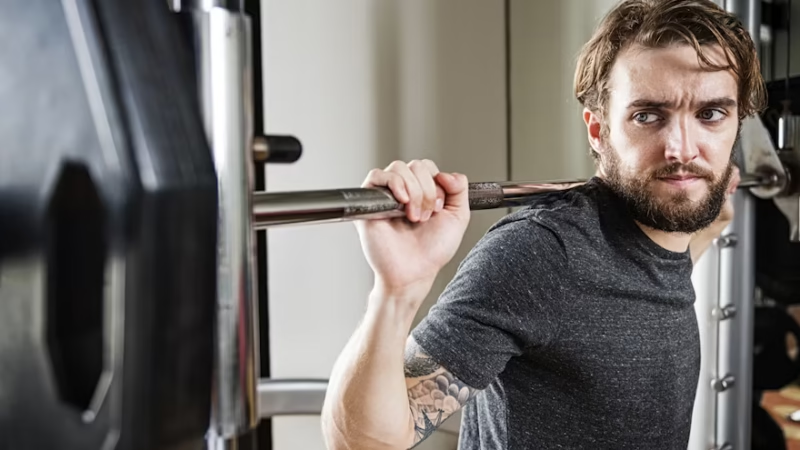
Picture this: You’ve got your macros dialed in to the exact gram. You’re running a brutal 4-day upper/lower split, progressively overloading your compound lifts, and slamming your post-workout whey like clockwork. You feel like you’re doing everything right. But then you step under the bar for a heavy squat session after four hours of broken sleep, and 85% of your 1RM staples you to the pins.
You feel weak, flat, and unmotivated. If you think you can just dry-scoop more pre-workout and out-train a garbage recovery schedule, you’re lying to yourself. The hard truth is that sleep deprivation kills muscle gains, and it does it faster than missing meals or skipping leg day.
Muscle isn’t built in the gym; it’s torn down on the gym floor and rebuilt in your bed. Let’s pop the hood on your physiology and break down exactly why shortchanging your sleep is the fastest way to stay small and weak.
Exactly Why Sleep Deprivation Kills Muscle Gains
When you cut your sleep short, you aren’t just feeling “a little groggy.” You are fundamentally altering your body’s hormonal environment. You are shifting from an anabolic (muscle-building) state into a catabolic (muscle-wasting) state.
Let’s look at the actual biology of what happens when you decide to binge Netflix until 2 AM instead of getting your mandatory eight hours.
The Testosterone and Cortisol Seesaw
If you want to build thick, dense muscle tissue, testosterone is your best friend. But here is the kicker: the vast majority of your daily testosterone production happens while you are in deep sleep. Skip that deep sleep, and your T-levels tank.
Studies have shown that healthy young guys sleeping just five hours a night for a single week experienced a 10% to 15% drop in daytime testosterone levels. To put that in perspective, that’s the equivalent of aging a full decade in just seven days. Because sleep deprivation kills muscle gains at the hormonal level, your body literally lacks the chemical signal to synthesize new proteins.
Simultaneously, poor sleep causes a massive spike in cortisol, your body’s primary stress hormone. Elevated cortisol blunts protein synthesis and signals your body to break down amino acids from muscle tissue for quick energy. High cortisol and low testosterone is the ultimate recipe for a physique plateau.
Growth Hormone and Slow-Wave Sleep
Human Growth Hormone (HGH) is responsible for tissue repair, fat metabolism, and cellular regeneration. Roughly 70% of your daily HGH pulse happens during Slow-Wave Sleep (SWS), which is the deepest phase of your sleep cycle.
When you only sleep five or six hours, your body naturally prioritizes REM sleep (for brain function) over SWS. You are actively robbing your muscles of the HGH they need to repair the micro-tears you caused during those heavy sets of Romanian deadlifts.
CNS Fatigue: Why Your Heavy Sets Feel Like Garbage
Your Central Nervous System (CNS) is the command center that fires the electrical signals to your muscles. To lift heavy weight, your CNS needs to recruit high-threshold motor units fast and efficiently.
When you are sleep-deprived, your CNS is fried. The electrical output from your brain to your muscles is weakened. This is why a weight that you normally rep out for an easy set of 8 suddenly feels like a grinding 3-rep max.
A fatigued CNS also ruins your proprioception (your awareness of your body in space) and your biomechanics. When your form breaks down on a heavy compound movement because your nervous system is lagging, you are begging for a blown-out lower back or a torn pec. (Disclaimer: If you do experience sharp pain or tweak something in the gym, stop lifting and consult a licensed physical therapist immediately—don’t try to roll it out and pray.)

Insulin Resistance: Getting Fat While Losing Muscle
Here’s where things get really ugly. Even just a few nights of bad sleep completely wrecks your body’s insulin sensitivity. Your cells become resistant to insulin, meaning your body has to pump out way more of it just to manage your blood sugar.
Why does a lifter care about insulin? Because insulin is a transport hormone. When you are insulin sensitive, the carbs you eat are shuttled directly into your muscle cells to replenish glycogen stores. Your muscles look full, vascular, and pumped.
When bad sleep makes you insulin resistant, those same exact macros are far more likely to be shuttled into adipose tissue (body fat). So, not only does poor sleep stop hypertrophy dead in its tracks, but it actively makes you fatter on the same diet.
Damage Control: How to Train When You’re Sleep Deprived
Look, life happens. Maybe you have a newborn, you’re working the graveyard shift, or finals week is kicking your ass. You are going to have days where you roll into the gym running on fumes. Here is how you autoregulate your training so you don’t dig a deeper recovery hole.
- Drop the Volume, Keep the Intensity: If your program calls for 4 sets of 8 on the bench press, drop it down to 2 sets. Keep the weight heavy enough to provide a mechanical stimulus, but cut out the junk volume that your body cannot recover from.
- Cap Your RIR (Reps in Reserve): Today is not the day to take sets to absolute failure (RPE 10). Leave 2 to 3 reps in the tank on every single set. Taking sets to failure on zero sleep heavily taxes an already exhausted CNS.
- Ditch the Barbell for Machines: If your CNS is trashed and your lower back feels sketchy, don’t force barbell squats. Swap them out for a hack squat or leg press. Machines require less stabilization and neurological drive, making them safer when you’re fatigued.
- Extend Your Rest Periods: Your ATP (cellular energy) replenishes much slower when you’re exhausted. If you normally rest 90 seconds between sets, bump it up to 3 minutes. Give your body a fighting chance to clear lactic acid.
Pro-Tip: The Elite “Sleep Stack” for Hypertrophy
If you wanna fix your sleep architecture, you need a pre-bed routine that down-regulates your nervous system. Stop relying on cheap, over-the-counter melatonin—it often causes dependency and leaves you feeling groggy the next morning. Instead, try this science-backed protocol 45 minutes before hitting the pillow.
- Magnesium Bisglycinate (200-400mg): Most lifters are deficient in magnesium due to sweating. The bisglycinate form crosses the blood-brain barrier easily and actively lowers core body temperature, signaling your brain that it’s time to sleep.
- L-Theanine (100-200mg): An amino acid found in green tea that increases GABA levels in the brain, promoting a state of calm relaxation without acting as a heavy sedative.
- Apigenin (50mg): An extract from chamomile that binds to specific receptors in your brain to decrease anxiety and shut off that racing “monkey mind” that keeps you awake.
- Temperature Control: Set your bedroom thermostat to 65°F (18°C). Your core temperature needs to drop by about 2 degrees to initiate and maintain deep sleep.
The Bottom Line on Sleep and Gains
It’s time to stop glorifying the “team no sleep” hustle culture. If you are serious about building a dense, powerful physique, you have to treat your time in bed with the exact same respect and discipline that you treat your time at the squat rack.
Stop searching for a magic supplement or a secret Russian peaking program to break your plateau. If you aren’t logging 7 to 9 hours of quality sleep every single night, you are leaving massive gains on the table. We know for a fact that sleep deprivation kills muscle gains, wrecks your hormones, and fries your nervous system. Turn off your phone, black out your room, and go to sleep. Your PRs depend on it.