You’ve been there. You’re standing at the cable station doing your third set of flyes, and some guy walks over, looks at you like you just committed a felony, and says, “Bro, you should be benching. Machines are for beginners.” Two weeks later, your buddy swears the leg press is the only reason his quads finally grew. So what gives?
The free weights vs machines for muscle growth debate is one of the most recycled arguments in the gym — and most of the takes are either oversimplified or just flat-out wrong. Let’s settle this with some actual science and real-world programming logic, not broscience passed down from the 1980s.
The Core Difference: Stability Demand vs. Targeted Overload
Here’s the thing — free weights and machines train your muscles differently, not better or worse. Understanding that distinction is everything.
When you pick up a barbell or a pair of dumbbells, your body has to recruit stabilizer muscles to control the load through space. That’s neuromuscular demand on top of mechanical tension. With a machine, the movement path is fixed, which removes that stabilization requirement entirely — but it also means you can push the target muscle harder and with less systemic fatigue.
Neither approach is “cheating.” They’re just different tools with different tradeoffs.
What the Research Actually Says
A 2020 meta-analysis published in the Journal of Human Kinetics found no significant difference in hypertrophy outcomes between free weights and machine-based training when volume and effort were equated. Let that sink in. If you’re taking sets close to failure and hitting your weekly volume targets, both modalities will grow muscle.
Where free weights have an edge:
- Compound strength carryover — Barbell squats, deadlifts, and bench press build functional strength and inter-muscular coordination that machines simply can’t replicate.
- Hormonal response — Heavy compound free weight movements tend to drive a greater acute hormonal response (testosterone, GH) due to the sheer amount of muscle mass recruited.
- Long-term athletic development — If you care about being strong outside the gym, free weights win here.
Where machines have an edge:
- Isolation and pump work — A cable lateral raise or a pec deck fly lets you absolutely torch a muscle without taxing your CNS the way a heavy pressing session does.
- Training frequency and recovery — Machine work is easier to recover from, which means you can train a muscle more often throughout the week.
- Beginner and injury contexts — Machines reduce injury risk when technique is still developing, or when managing a nagging shoulder or knee issue. (Disclaimer: if you’re dealing with a real injury, consult a licensed physical therapist before modifying your training.)
- Constant tension — Cable machines in particular maintain tension throughout the full ROM, which is a legit mechanical advantage for hypertrophy.
How Intermediate Lifters Should Actually Program This
If you’re past the beginner stage — meaning you’ve got a year or more of consistent, structured training under your belt — you don’t need to pick sides. The smart play is to use both strategically.
Here’s a simple framework:
Primary Compound Movements (Free Weights) — Sets of 4–6 or 3–5 reps
Start your session with the big movers. Barbell bench, squat, Romanian deadlift, overhead press. These are your strength builders. Keep reps lower and intensity high. Think 80–85% of your 1RM, leaving 2–3 RIR (reps in reserve).
Secondary Movements (Free Weights or Machines) — Sets of 8–12 reps
Dumbbell incline press, Bulgarian split squats, cable rows. This is your hypertrophy bread-and-butter zone. Aim for 1–2 RIR on most sets. You can use free weights or machines here — match the tool to the muscle you’re trying to develop.
Isolation Finishers (Machines/Cables) — Sets of 12–20 reps
Pec deck, leg curl, cable lateral raises, face pulls. High rep, high pump, low systemic stress. These are killer for bringing up lagging muscle groups without beating up your joints or spiking DOMS so hard you can’t train again for five days. Take these to 0–1 RIR.
Pro Tip: If you’re running a 4-day upper/lower split, a solid structure is: compound free weight movements first (40% of your volume), followed by secondary movements (35%), then machine finishers (25%). That ratio keeps your strength progressing while maximizing hypertrophy stimulus across the session.
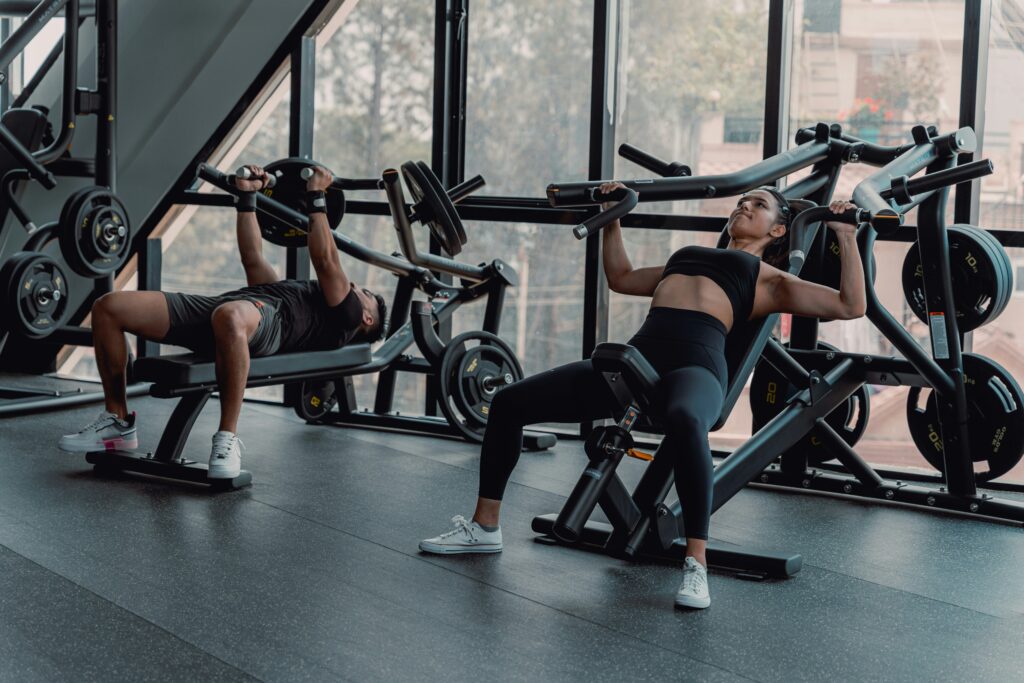
Free Weights vs Machines For Muscle Growth: Common Mistakes to Avoid
Whether you’re team barbell or team cable stack, these mistakes will kill your gains regardless:
- Ego loading on machines — Just ’cause the weight feels easier on a machine doesn’t mean you should pile on plates and half-rep it. Full ROM matters just as much here.
- Skipping compound lifts entirely — Guys who do nothing but machines often hit a ceiling on their strength and functional size. You need that barbell work. Period.
- Under-loading on isolation work — Machine lateral raises done with baby weight for 30 “rep” sets where you’re barely breaking a sweat aren’t doing anything. Push close to failure.
- No progressive overload — Doesn’t matter if it’s a dumbbell or a selectorized lat pulldown. If you’re not adding reps, weight, or sets over time, you’re spinning your wheels.
The Bottom Line
Stop letting gym dogma dictate your programming. The free weights vs machines muscle growth debate has a pretty clean answer: use both, use them intelligently, and get your sets close to failure.
Free weights build foundational strength, recruit more muscle mass, and carry over to real-world power. Machines let you isolate specific muscles, extend your training frequency, and pile on volume without torching your recovery. Together, they’re a complete toolkit.
Build your program around heavy compound movements, fill in the gaps with targeted machine work, and stay consistent. That’s how you actually grow — not by arguing about equipment on the gym floor.
Now go load the bar.